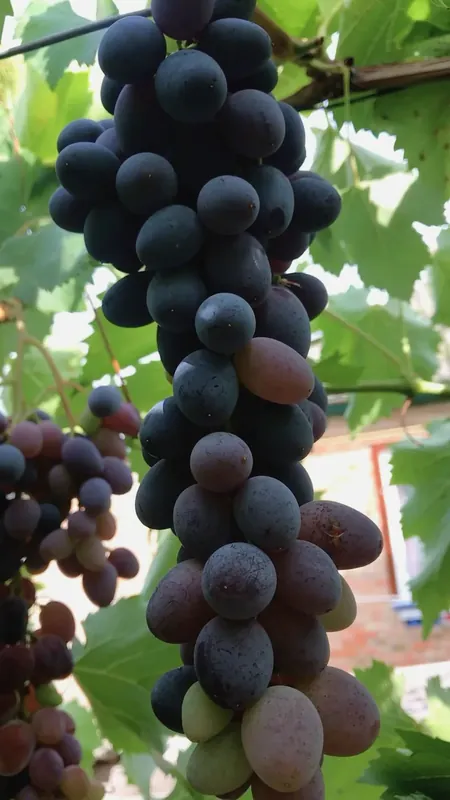
Article contents
Kishmish means seedless varieties: the berries have no hard seeds, though soft rudiments sometimes appear. The berries are usually smaller than in seeded varieties, and the taste ranges from Muscat to neutrally sweet. Choose by ripening time, frost resistance and color, just like ordinary grapes.
1What kishmish is
Kishmish is a group of grape varieties with seedless berries. Hard seeds do not develop in them: the ovary forms only small soft rudiments, which are usually unnoticeable when eating. So the berries can be eaten whole, and kishmish suits both fresh eating and drying (raisins).
2How kishmish differs from seeded varieties
- Berry size. Without additional treatment, kishmish berries are usually smaller than in seeded varieties. The clusters can be of excellent size while the berries are smaller.
- Taste. It varies: from bright Muscat to neutrally sweet. See the description of a specific variety.
- Use. Fresh berries, desserts, drying; many choose kishmish for children precisely because there are no seeds.
- Care. The agronomy is the same as for ordinary grapes: a sunny place, a support, timely pruning, winter cover for cover varieties.
3Which kishmish varieties are in our catalog
| Variety | Berry color | Ripening time | Winter hardiness | Cluster weight |
|---|---|---|---|---|
| Tsymus | Yellow | Extra-early | Needs winter cover, down to −23 °C | 800–1000 g |
| Korinka | Yellow | Extra-early | Needs winter cover, down to −26 °C | 180–250 g |
| Jupiter USA | Black | Early | No winter cover, down to −25 °C | 400–500 g |
| Veles | Pink | Early | Needs winter cover, down to −23 °C | 500–1500 g |
| Ratatouille | Yellow | Early-to-mid | Needs winter cover, down to −19 °C | 740–1200 g |
| Storichchia USA | Yellow | Early-to-mid | Needs winter cover, down to −21 °C | 800–1500 g |
| Avatar | Black | Mid-season | Needs winter cover, down to −21 °C | 500–1000 g |
| Mars | Black | Mid-season | No winter cover, down to −26 °C | 200–300 g |
These are the varieties in the catalog today; see availability and prices on each variety’s page. All the kishmish in the catalog can be filtered: in the filters choose “Type” → “Kishmish”.
4How to choose a kishmish variety
- Decide on the ripening timeFor cooler regions extra-early and early varieties are more reliable — they manage to ripen before the autumn cold.
- Check frost resistanceHere everything is the same as with ordinary grapes: the variety page states whether it needs winter cover and the approximate cold limit. About covering — in the article “How to cover grapes for winter”.
- Choose color and tasteWhite (yellow) and black kishmish differ in taste and appearance — go by the variety description.
- Look at the cluster sizeFor the table, large clusters are better; for drying, dense ones with uniform berries.
5Frequently asked questions
Does kishmish really have no seeds?
There are no hard seeds. Sometimes the berries contain soft seed rudiments — they are small and usually unnoticeable when eating.
Can raisins be made from kishmish?
Yes, kishmish is well suited for drying: it makes raisins. For drying, choose varieties that ripen fully and dry whole, dense clusters.
Is kishmish less frost-hardy?
No, frost resistance does not depend on whether there are seeds: each variety has its own. It is stated on the variety’s page — among kishmish there are both cover and no-cover varieties.